

- Featured
- Insigniam Perspectives
- IQ Insigniam Quarterly® Magazine
- The Hard Truths About How Organizations Transform
Want a Competitive Edge? Build a Moat.
Every leadership team is asking the same question: how do we win with AI? Budgets are being reallocated. Pilots are multiplying. Boards are demanding roadmaps. In many organizations, AI has become the centerpiece of the growth agenda for 2026 and beyond. The underlying assumption is rarely questioned. If we move faster, invest more, and deploy better tools, we will gain an advantage. Yet, that assumption is wrong.
AI is following the same economic path as every major general-purpose technology before it. Performance is improving rapidly, costs are falling, and access is expanding at scale. What begins as a differentiator quickly becomes infrastructure. What is scarce becomes widely available. What once separated leaders from laggards becomes table stakes.
Nicholas Carr made this argument nearly two decades ago in his Harvard Business Review article “IT Doesn’t Matter,” where he observed that as technologies become ubiquitous, they shift from sources of strategic advantage to essential utilities. That pattern is now repeating at unprecedented speed with AI.
Recent analysis from MIT Sloan Management Review reinforces this point. As large language models and AI tools become commoditized, their availability increases across industries, compressing any advantage derived from the technology itself. What remains is not the tool, but how it is used.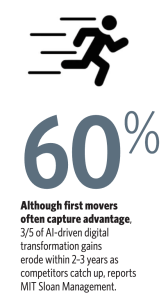
This is not a theoretical concern; it is already visible in the data. Goldman Sachs estimates that AI could add trillions in economic value globally, yet the distribution of that value will not be even. Many companies are experimenting, but far fewer are translating that experimentation into impact at scale—and when executives are asked why, the answer is rarely the technology itself. In a recent Hypothesis survey of 100 senior US executives at large enterprises, the obstacles they named were overwhelmingly about execution and readiness, not access to tools. The gap is not access to technology; it is the ability to translate that technology into performance.
The uncomfortable truth for executives is that AI will make most companies more similar, not more different.
The strategic question is no longer who adopts AI first. It is the organization that redesigns itself fastest to turn it into a system-level advantage.
Why Technology Stops Differentiating
There is a well-established body of research that explains why technology alone rarely produces sustained competitive advantage.
The resource-based view of the firm, developed by scholars such as Jay Barney—professor of strategic management at the University of Utah’s David Eccles School of Business—argues that for any asset to create lasting advantage, it must be valuable, rare, and difficult to imitate. Technology, by its nature, fails this test over time. As adoption spreads, it remains valuable but ceases to be rare or inimitable.
Empirical evidence supports this pattern. Studies examining enterprise technology adoption, including ERP systems, show that early adopters often experience short-term performance gains and positive market reactions. However, as adoption diffuses across competitors, those gains normalize. What was once an advantage becomes a baseline expectation.
This is not unique to AI. It is the predictable lifecycle of any transformative technology. In fact, electricity followed this path. Early factories that adopted electric power saw gains, but the real breakthrough came when companies redesigned production around continuous flow rather than simply replacing steam engines. The same pattern held for the internet, cloud computing, and mobile technologies. Early movers benefited temporarily. Long-term winners reorganized how work was done.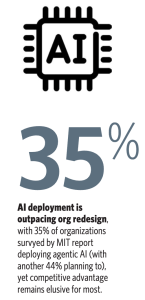
Generative AI is already moving through this cycle. What began as a breakthrough capability is rapidly becoming embedded in standard enterprise software.
Microsoft, Google, and others are integrating AI into core productivity tools, effectively making it part of the operating environment rather than a distinct advantage.
From a strategic perspective, this has profound implications. If a capability is widely accessible, it cannot be the basis of differentiation. It can improve performance. It can increase efficiency. It can even reshape industries. But it cannot, on its own, create a lasting edge. That edge must come from something else.
History Is Clear: Advantage Comes from Reorganization, Not Adoption
If technology does not create sustained advantage, what does?
History provides a consistent answer. Breakthrough performance occurs when organizations reorganize how work is done around new capabilities.
The introduction of steam power did not transform industry until production shifted into centralized factories. Electricity did not unlock productivity gains until companies redesigned layouts and workflows for flexibility and continuous operation. Henry Ford’s innovation was not the automobile itself, but the assembly line that redefined production.
More recently, companies such as Amazon, Google, and Netflix did not win because they had access to better technology. They won because they built operating models that leveraged technology in fundamentally different ways.
Amazon turned logistics, data, and fulfillment into an integrated system that competitors have struggled to replicate. Google redefined how information is ranked and monetized through a combination of algorithms, data, and organizational focus. Netflix transformed content production and distribution by aligning technology, data, and decision-making into a cohesive system.

In each case, the technology was necessary but not sufficient. The differentiator was how the organization was designed to use it.
Research published in Strategy+Business reinforces this point. Companies that realize outsized returns from digital investments consistently pair technology adoption with changes in processes, governance, and talent models. Those who do not tend to see limited or short-lived gains.
The pattern is clear: Technology enables new possibilities, yet organizations determine whether those possibilities translate into advantage.
The AI Illusion: Optimizing the Present Instead of Redesigning the Future
Most companies are approaching AI in a way that guarantees convergence rather than differentiation. They are using it to improve existing workflows, automate tasks, accelerate processes, and optimize current operations. These efforts are valuable, but they are inherently incremental; they make the organization more efficient, but they do not make it fundamentally different.
This is the core illusion of AI adoption. Because the technology is powerful, it creates the impression that applying it will transform the business. In reality, applying AI to an unchanged operating model often reinforces existing constraints.
The same Hypothesis research makes those barriers concrete, and they are organizational rather than technical. Asked where their organizations most overestimate readiness when taking on a major initiative, executives pointed to the ability to translate strategy into actionable plans (23%) and change management and employee adoption (20%)—not to the tools themselves. Asked what actually undermines major initiatives, they named a lack of capacity to sustain the effort (36%), decisions made with incomplete context (35%), and execution drifting from its original intent (32%). These are failures of the operating model, not technology.
The pattern repeats at the frontline. Nearly a third of executives (28%) say change in their organizations gets treated as technical rather than organizational—new tools layered onto existing systems without a change in how work actually gets done. Behaviors stay the same, so results do too.
The consequence is predictable. Two companies can deploy the same AI tools and achieve vastly different outcomes.
One sees marginal efficiency gains. The other creates a step-change in performance. Therefore, the difference is not the technology; it is the system in which the technology operates.
Where Real Competitive Advantage Now Lives
As AI becomes ubiquitous, differentiation shifts to what cannot be easily copied. This is where the concept of complements becomes critical. Complements are the organizational elements that determine how effectively a technology is used. They include data, processes, routines, talent, and the alignment across them.
As Harvard Business School’s Michael Porter argues in What Is Strategy, competitive advantage grows out of the entire system of a company’s activities rather than any single one. The fit among those activities is what meaningfully reduces cost or increases differentiation—and that same fit is what locks out imitators, because a chain of interlocking activities is far harder to copy than any individual link.
Furthermore, David Teece—a professor at the University of California’s Haas School of Business—extends this idea by focusing on a firm’s ability to continuously reconfigure its resources and processes. In Dynamic Capabilities and Strategic Management, he frames these as a firm’s ability to “integrate, build, and reconfigure internal and external competences” as fast-moving conditions demand.
These capabilities are deeply embedded in how work gets done. They are reflected in decision-making routines, coordination mechanisms, and leadership behaviors. They are shaped by history and reinforced through practice.

Because they are tacit and path-dependent, they are difficult to replicate. This is where real moats now come from.
Proprietary data is one example, but its value depends on governance, quality, and accessibility. Organizational routines, such as how decisions are made and executed, determine speed and effectiveness. Integrated processes across functions enable or constrain performance. Talent and incentives shape behavior. The fit across these elements creates a system that is greater than the sum of its parts.
Research across multiple domains supports this view. Studies on IT and organizational performance consistently show that technology investments yield higher returns when paired with complementary human and organizational practices. Lean transformation case studies demonstrate that tools alone do not drive results; it is the underlying way of working that matters.
Even attempts to replicate best practices often fail because they do not account for these embedded factors. As research on path dependence shows, organizations are shaped by their history, and changing deeply ingrained routines is difficult.
This is why two companies using the same technology can diverge so dramatically in performance: The technology is visible, but the system behind it is not.
The Challenger Question Every Executive Must Answer
If technology is no longer the source of differentiation, the question for leaders becomes more fundamental. For instance, ask yourself, “Which of our ways of working would still outperform a competitor using the same tools?”
This question shifts the focus of strategy. It moves the conversation away from technology selection and toward organizational design.
It forces leaders to examine how decisions are made, how work flows across the enterprise, and how incentives drive behavior. It exposes whether the organization is built for speed, learning, and execution. It also reveals where the organization is constrained.
Many companies discover that their greatest barriers to performance are not external; they are internal. Decision-making is slow or fragmented. Accountability is unclear. Processes are optimized locally but not end-to-end. Incentives reward individual performance rather than collective outcomes. Executives often recognize this only in hindsight: nearly a third (29%) admit they were overconfident in their ability to handle major initiatives on their own. As one financial services CEO put it, “We thought we could handle everything internally, but it quickly got more complicated than expected.” AI does not solve these problems—it amplifies them.
Organizations that fail to address these constraints will find that AI increases activity without improving results. Those who redesign their operating model will find that AI becomes a force multiplier.
What Leaders Must Consider Now
The implications for the C-suite are immediate and practical. AI cannot be treated as a technology initiative. It must be treated as an operating model transformation.
This begins with clarity about where value is created. Leaders must identify the critical decisions, workflows, and interactions that drive performance. They must understand how these elements are currently configured and where they create friction. From there, the focus shifts to redesign.
Decision rights must be aligned with speed and accountability. Workflows must be restructured to enable cross-functional execution. Incentives must reinforce desired behaviors. Data must be governed in a way that supports real-time insight and action.
This is not a one-time effort. It requires continuous adaptation.
Research from MIT Sloan Management Review suggests that organizations that build strong dynamic capabilities are better positioned to respond to change and sustain performance. These capabilities are not built through technology alone. They are built through leadership, culture, and disciplined execution.
Furthermore, the role of leadership is critical. Executives must move beyond sponsoring AI initiatives to actively reshaping how their organizations operate. They must be willing to challenge existing structures and make trade-offs.
This is where many transformations fail. The changes required are not technical. They are organizational and behavioral.
They require leaders to rethink how power is distributed, how decisions are made, and how performance is measured.
The Real Source of Advantage in the AI Era
The narrative around AI is often framed in terms of capability. What can the technology do? How fast is it improving? How broadly can it be applied?
These are important questions, but they are not the ones that determine competitive advantage.
The real question is how organizations use that capability to create something that competitors cannot easily replicate. Technology adoption makes companies better, and organizational redesign makes them different. In the AI era, that difference is what will separate those who lead from those who converge.
The companies that win will not be those with the most advanced tools. They will be those who rewire how work gets done, align their systems for execution, and build organizations that can continuously adapt.
AI will not save you. But it will reveal whether your organization is built to compete.