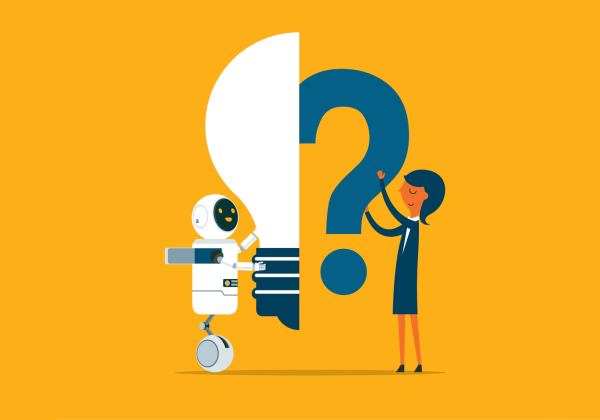

Shift Your (AI) Center of Gravity
I had a conversation with a CEO last month that I keep coming back to. He’d just signed off on a fresh round of AI pilots, the kind that look impressive in a steering committee. Productivity tools for sales. A copilot for the legal team. A chatbot in customer service.
He asked me, half proud and half puzzled, why none of it was showing up in his numbers.
I told him what I’ve been telling a lot of leaders. The pilots aren’t the problem. The center of gravity has moved, and the org chart hasn’t noticed.
Something fundamental shifted in the last twelve months, and most companies are still operating as if it didn’t. The frontier models stopped being assistants and started being employees. GPT-5-Codex now runs autonomously for seven hours on a single task. Anthropic trained its latest Claude model with sub-agent orchestration as an explicit objective, meaning, the system was built to manage other systems doing real work. Goldman Sachs deployed Devin (a coding assistant) alongside its twelve thousand developers and started describing the result, on the record, as a “hybrid workforce.” This is not a roadmap. It’s actually happening.
There are other signals worth noting as well. The Big Five hyperscalers will spend somewhere north of $660 billion (USD) on infrastructure in 2026, roughly three-quarters of it for AI, and the binding constraint is no longer chips, it’s electricity. Marc Benioff cut 4,000 jobs at Salesforce in September and said the quiet part out loud: “I need less heads.” Tobi Lütke told the entire Shopify organization that “reflexive AI usage is now a baseline expectation,” folded it into 360 reviews, and required teams to prove AI couldn’t do the work before getting more headcount. Amazon has cut roughly 30,000 roles in the last twelve months, citing the same underlying logic. None of this is speculative. It is already in the financials, already in the org charts, already in the way work is being assigned.
What’s changed isn’t the technology. It’s where value is created. Work is migrating from human execution to system execution, from individual effort to orchestrated workflows, from static processes to dynamic ones that learn between runs. The unit of productivity is no longer “what one person can do in a day.” It’s “what one person can direct across a team of digital coworkers in a day.” That is a different job.
And here is the paradox that the executives I talk to are starting to wrestle with. Productive individuals do not equal productive organizations. An MIT study this past fall found that 95% percent of enterprise AI pilots delivered no measurable return, in the same window that the AI-native cohort scaled faster than any group in the history of technology. Same models. Same vendors. Same budgets. Polar opposite outcomes.
The reason shouldn’t be surprising. When you bolt AI onto roles that were defined for the pre-AI era, you make individuals feel faster while the organization stays exactly as stuck as it was. Bottlenecks don’t disappear. They migrate. The “10x developer” generates more code than the reviewer can read, the architect can integrate, or the platform can deploy. Shadow AI quietly fills the gaps that policy refuses to acknowledge. Usage metrics climb while transformation depth stays flat. The CIO sees adoption rising and pilots failing and can’t reconcile the two. High usage with no redesign is how you build capability into the tool and out of the person at the same time.
This is the divergence that is starting to separate the companies that will matter in five years from the ones that won’t, and it does not look like a technology gap. Amazon didn’t beat Barnes & Noble because Barnes & Noble lacked internet access. Barnes & Noble had a website. Amazon won because it reorganized everything around what the internet made possible: infinite shelf space, logistics as a core competency, and customer data as a strategic asset. Barnes & Noble used the internet to sell books the same way they always had. Most AI programs right now are Barnes & Noble strategies. Companies are selling books online. The five percent who are pulling away aren’t running better pilots. They are redesigning the factory.

The hardest part of all of this is what it asks of leaders, and it is not what most leaders expect. The technical questions are the easy ones. The harder ones are about identity, accountability, and what we still owe each other when the work itself is changing shape. There’s a study OpenAI ran with the MIT Media Lab earlier this year on heavy ChatGPT users, and the finding that has stayed with me is this: the model’s responses are often judged more empathetic than human ones, but the people receiving them feel less heard. The quality of the words went up. The experience of connection went down. Simulation isn’t the point.
That is the line I’d offer to anyone trying to read where this is going. The work AI is taking over is the work that can be specified. The work that’s left, and the work that’s about to matter most, is the work that can’t. Judgment under genuine uncertainty. Holding a room when the room is afraid. Deciding what a company is for. Looking a colleague in the eye and telling them the truth about what you’re seeing.
The center of gravity has moved. The question is whether your organization moves with it, or finds out the hard way that the ground beneath it isn’t where it used to be.