

Execution: Why Results Fail to Launch
Watch a magician closely and you’ll learn something unsettling. The trick isn’t in what you’re looking at. It’s in what you’re not.
Misdirection is the entire art form. The magician doesn’t hide the coin — she points your eyes at her left hand while her right hand does the work. The audience leaves convinced they saw everything. They didn’t. They saw exactly what the magician wanted them to see, and the rest of the stage was invisible to them by design. This is also, more or less, the relationship most executives have with their own organizations.
The strategy is articulated. The OKRs cascade. The dashboards illuminate. Quarterly reviews are calendared, attended, and minuted. By every visible measure, the leadership team is doing the work. And yet, quarter after quarter, the results don’t move the way the plan said they would.
Initiatives that were green a month ago are yellow now. Yellow becomes red. The board asks pointed questions. Someone proposes a transformation office. A consultant arrives. Another dashboard appears. None of it works, because none of it is looking at the right hand.
The hard truth that most executives have not yet been told—and that some, when told, refuse to believe—is that what looks like an execution problem almost never is one. The plan isn’t broken. The people aren’t lazy. The strategy doesn’t need refinement.
What’s broken is the operating system underneath all of it: the unwritten rules of who actually decides, who can quietly veto, what gets rewarded versus what gets said in the slide deck, and which decisions are even visible as decisions in the first place.

That operating system is invisible to the people who designed it. By definition. You can’t redesign what you can’t see.
And here is the part that should keep CXOs up at night: the dashboards aren’t going to show it to you. The dashboards are the magician’s left hand.
What the Data Actually Says
In March 2026, Hypothesis Group—an Elixirr company—surveyed 100 senior executives at U.S. enterprises with $1 billion (USD) or more in annual revenue. The questions were about consulting. The answers were about execution. One finding was so stark it warrants reading twice.
When asked what most often undermines the success of major initiatives, 52% of senior vice presidents and vice presidents cited “execution drifted from original intent.” Among C-Suite executives at the same companies, the figure was 17%. Same enterprises. Same initiatives. Same dashboards. A 35-point gap on what’s going wrong.
This is not noise. This is two different organizations describing the same reality from different vantage points, and the C-Suite is the vantage point that doesn’t have visibility. The people closest to the work see execution drift as the dominant failure mode. The people defining the work barely see it at all.
You are reading this on a screen, probably from one of those two vantage points. If you are in the C-Suite, the natural reaction to a 17% number is that it doesn’t sound like the dominant problem. If you are an SVP or a VP, the natural reaction is, of course, that’s the problem; everyone knows that.
The fact that your reaction reveals where you sit on the org chart is itself the diagnosis.
The same study found that 23% of senior executives identified “ability to translate strategy into actionable plans” as the area where their organization most overestimates its readiness. These are not capability gaps. What showed up is a structural blind spot: the conviction that the organization can convert intent into prioritized, accountable execution, and the operational evidence that it cannot.
The figure most often cited in the trade press is the Harvard Business Review finding that 67% of well-formulated strategies fail in execution. It has been quoted for so long that it has begun to feel decorative. The new finding is sharper. Strategies aren’t failing in execution. They’re failing in visibility. The execution system is doing exactly what it was designed to do—and what it was designed to do is not what the executive thought.
Manufacturing Results
The pattern is most acute in industries where the cost of execution drift compounds fastest. Manufacturing is one of them. Hypothesis found that 55% of manufacturing and industrial companies cite a major strategic shift or growth initiative as the trigger for engaging external help — the highest of any industry surveyed. Stakes are visibly high. Margins are visibly thin. The gap between “we said we’d ship 18” and “we shipped 6” cannot be smoothed over by a deck.
Talk to senior leaders in manufacturing right now, and a familiar dynamic surfaces. Many describe what they call a “GDP-minus” environment: growth that lags the broader economy, where assumptions about market-driven performance no longer hold. In this environment, the commercial function becomes a primary lever. And the commercial function is where execution drift becomes most visible, because every drift translates immediately into a number.
Tim Romberger, founder and principal of TRC Advisory—an Elixirr company—works closely with manufacturing executives on the commercial side of their business and describes the issue directly: “Many manufacturers continue to operate with models that were designed for a different era,” Mr. Romberger says.
“Sales organizations are structured to maintain existing revenue rather than generate new growth. Effort is spread across a wide range of opportunities, without clear prioritization.”
The result, he observes, is a familiar pattern. Activity is high. Pipeline conversion varies. Pricing discipline is uneven. Resources are not always aligned with the highest-value opportunities. The strategy is clear; the execution does not deliver on it.
Notice what is and isn’t being said. The strategy is fine. The people are working. The activity is real. The execution doesn’t follow.
Why? Because (and here is the misdirection) the people running the commercial function are operating inside an unwritten set of rules about what’s actually rewarded. Rules that were established years ago, by leaders who are no longer in the room, in conditions that no longer exist. Those rules govern who gets credit for what. Which deals are “worth fighting for.” How pricing exceptions are quietly granted. Which accounts are protected even when they shouldn’t be. None of that appears on the dashboard.
The operational side of the house has its own version of the same problem. Rory Farquharson, an Elixirr partner who frequently counsels manufacturing executives, observes that production environments have become structurally harder to read.
“Manufacturing environments have become more complex,” Mr. Farquharson says. “Supply chains are less predictable. Production systems rely on a mix of legacy infrastructure and newer digital tools.”
Many organizations have invested heavily in tracking and reporting — and yet, real-time visibility remains limited. Data is not always integrated across systems. Decision-making lags behind events on the ground.
“When execution gaps occur,” Mr. Farquharson notes, “they tend to surface first in operational metrics. Throughput becomes inconsistent. Delivery performance slips. Safety incidents increase. Financial impact almost always follows later.”
This is the second tell. By the time the financial impact shows up—which is the layer the C-Suite tends to be looking at—the execution failure has already been visible for weeks or months in the operational telemetry. The dashboard at the top of the house catches the symptom; the dashboard near the work catches the disease. Both dashboards are real. Only one of them is being watched by the people who can actually act.
Mike Stow, vice president of global marketing for surgical robotics at Medtronic, captured the diagnostic problem directly when asked how he assesses where performance is breaking down.
“The root cause likely isn’t as simple as structure, execution, or the underlying ways teams work together,” Mr. Stow said. “It likely lies deeper and across all three. Too often we look for simple answers to complex problems.” He continues: “We need to look more holistically and be willing to understand why some initiatives succeed and others fail.”
Most organizations don’t. Most organizations diagnose execution failure as a behavioral problem and respond with behavioral interventions. Tighter governance. Sharper KPIs. Clearer expectations. More town halls. Each move is logical inside the existing context — and each one fails to surface the context, which is the only thing that would actually change the outcome.
What the Executive Cannot See, and Why
There is a methodology that begins, before anything else, by making the operating system visible. At Insigniam, the first step is to reveal. What surfaces is not what most executives expect. It is rarely a single dramatic dysfunction. It is, more often, a quiet inventory of normalcy. The way decisions actually get made. Who is genuinely consulted versus who is informed for the sake of appearance? Which meetings are real and which are theater?
The phrase that’s used in the hallway after the meeting contradicts the phrase used in the meeting itself. The senior leader everyone has learned to route around. The function that has, without anyone deciding, accumulated a quiet veto.
None of this is hidden, exactly. Most of it is known to most of the people doing the work. What’s hidden is its aggregation — the way these unspoken rules combine into a coherent operating system that produces the outcomes the dashboards are measuring. The dashboard sees the output. The methodology surfaces the system that produced the output.
The next move—unhook—is the part most leaders find genuinely difficult. It is the deliberate act of disengaging from the prevailing mindset. The unwritten rules don’t leave on their own; they reassert themselves the moment a new initiative is introduced, retranslating it into the old way of thinking. Without unhooking, the new strategy gets quietly absorbed into the old operating system and emerges, six months later, looking suspiciously like everything that came before. Senior leaders who have lived inside the system for years are themselves the principal carriers of the rules. Asking them to redesign the system without unhooking is asking the magician to spot her own misdirection.
Only then does the real work begin: inventing a different operating context, then implementing it. This practice for enabling successful change describes the move as installing clear decision rights, accountabilities, leadership actions, and processes; but only after the existing ones are revealed. The sequence matters. Most failed transformations install new decision rights on top of unrevealed old ones. The new rights live in the policy document; the old rights continue to govern actual behavior.
This is not jargon. It is a description of why execution failure cannot be solved by adding mechanisms—more dashboards, more reviews, more governance—to a system whose problem is that the existing mechanisms are already invisible to the people running them.
Same Patterns, Different Industries
Consider a North American biopharma company in 2026. Twenty years old, deeply respected for its scientific rigor, approaching late-stage development on its first commercial-ready product with several more candidates in the pipeline. The organization had nearly doubled in size in the run-up to commercialization. Regulatory timelines were tightening. The board was asking commercial questions of a leadership team built for science.
By every visible measure, the company was working. Meetings were happening. Updates were flowing. The senior executive team was reviewing decisions promptly. And yet, somehow, decisions were taking forever.
When the company brought in outside diagnostic help, what surfaced was not a capability problem. It was a culture of consensus-by-default, in which product development teams had grown accustomed to escalating most non-trivial decisions upward to the senior executive team. The unwritten rule was that you didn’t make a call alone if you could get the room to agree first. Twenty years of scientific collaboration had trained the organization to value alignment over velocity. The result was an organization that could not move at the pace commercialization required.
The fix wasn’t a new dashboard. It was deliberately reassigning decision-making authority away from the senior executive team and to the product development teams. This installed a matrixed operating model in which decisions had to live closer to the work. Senior leaders had to learn to stop being bottlenecks. Product development teams had to learn that they were trusted to decide. Neither was easy. Both were necessary.
The result was a 200% productivity improvement and decisions that landed in days rather than weeks. The strategy had not changed. The capability had not changed. The visible part of the system had not changed. What changed was the invisible part—and once it was visible, it could be redesigned.
A different aircraft manufacturer faced a different version of the same problem. A flagship jet program, $20 million per aircraft, had cratered: forecast 18 deliveries for the year, on track for 6. Each plane coming off the line had more than 400 errors. Cost overruns ran into the millions per aircraft.
The diagnosis everyone reached for was capability: engineering, supplier quality, and manufacturing skill. The diagnosis that turned out to be correct was that the program had become a self-reinforcing loop. People were blaming abstract groups (“engineering” or “quality”) instead of making direct requests of named individuals.
Estimated completion dates had quietly replaced actual commitments. Problems were pushed down the line until they arrived at the last station as fully assembled defects.
The unwritten rules said don’t be the one who escalates, don’t be the one who makes another team look bad, don’t be the one who stops the line.
When the rules got named and broken, the team committed to delivering 23 aircraft instead of the projected 5. They delivered 23. Person-hours per aircraft dropped by more than 2,400. Material costs fell 10%. Over the full engagement, more than $400 million dropped to the bottom line.
These are not stories about heroic individual effort. They are stories about what happens when an organization stops measuring its left hand and starts looking at its right.
The largest version of this same diagnosis, in living memory, is Boeing. The 737 MAX program had a clear strategy: deliver a more fuel-efficient narrow-body jet, faster to market than Airbus’s A320neo, without forcing airlines to retrain pilots. The strategy was articulated. The capability was real—Boeing had built more 737s than any other commercial aircraft in history. What failed was the operating system underneath: an unwritten set of rules about who could escalate engineering concerns, what got rewarded versus what got tolerated, and which decisions about flight-control software were treated as decisions at all. The cost of that invisible system, by the time it was revealed, was 346 lives, two grounded aircraft fleets, multiple criminal proceedings, and a brand that has not yet recovered. None of it appeared on the dashboards. All of it was, in retrospect, knowable.
The Agentic Complication
There is a contemporary wrinkle that makes this more urgent in 2026 than at any prior point in modern executive memory.
Agentic AI is forcing decision rights into the open whether organizations want to look at them or not. When an AI agent inherits permissions from an overprovisioned human and acts in seconds, the unwritten rules of “who can really do what” become operationally consequential at machine speed. You can no longer rely on the human pause — the moment when an employee thinks, I’m not sure I should do this, and walks down the hall to ask.
In its 2026 Secure Access in the Age of AI research, Hypothesis Group, working with Microsoft Security, surveyed 305 enterprise access management decision-makers. Six in ten leaders anticipate more access incidents from AI agents and employee GenAI use. 80% report that AI agent use has increased in the past year. Sixty percent say agents operate autonomously with limited oversight. More than half say agents require broad or elevated permissions to systems and data.
The unwritten rules of human decision rights, in other words, are being copied directly into AI systems—and those systems then act on the unwritten rules at scale, in real time, without the human pause that used to provide a margin of safety. The execution failures that used to take a quarter to surface are now arriving in days.
A CISO in financial services, interviewed during the qualitative phase of the study, put it directly: “Even with many different tools, we still don’t end up getting the entire risk picture.” Tool sprawl is not protection. It is exposure. The organizations with six or more access management tools are reporting more AI-related incidents than those with fewer—67% versus 47% on GenAI; 64% versus 51% on agentic AI. Adding more visible mechanisms to a system whose actual problem is invisible governance produces, predictably, more failure.
The pattern is the same one that broke the jet program in 2009 and slowed the biopharma in 2026. The technology is new; the diagnosis is not.
What This Means for You
If you are sitting with a strategy you believe in and execution that isn’t delivering, the honest first question is not how do we fix execution. It is what am I being misdirected away from. The dashboards you trust were built on the assumptions of the system that’s failing. They are doing their job. Their job is not to surface what they were never asked to see.
The work begins with making the operating system visible. That is uncomfortable, because the operating system is built on choices senior leaders made, often without naming them as choices. It is built on what those leaders, over the years, allowed and rewarded. It is built on what got tolerated when no one was officially watching. Surfacing it is not a comfortable exercise. It is also the only one that produces a durable answer.
CXOs willing to do this work—to ask not “who is failing to execute” but “what about how we operate is making execution structurally unlikely”—are the ones who will outperform the market and overcome the hard truths. Their strategies, over time, are the ones that show up in the numbers. Meanwhile, their competition will be all too busy watching the left hand.
Executive Perspective
Peter Alkema, Head of IS Technology & Platforms, ABB

Peter Alkema is Head of IS Technology & Platforms at ABB, where he leads enterprise technology strategy and platform development across global operations. With experience in manufacturing and financial services, he focuses on how IT enables execution at scale, from modernizing legacy systems to embedding agility. His work connects technology, operations, and leadership, showing how system design, data architecture, and organizational behavior shape performance.
IQ: Where do data and systems break down in supporting performance, and how can organizations improve responsiveness?
Mr. Alkema: The first issue is simply that there are too many systems and too many sources of data. You end up with productivity leakage as people spend time trying to join the dots across multiple platforms. Every new tool promises to solve a problem, but over time, organizations accumulate layers of systems, processes, and dependencies that make execution harder rather than easier. We’re very good at adding new tools, but not very good at taking things away. That is where legacy starts to become a real bottleneck on performance. It creates technical debt, forces trade-offs during implementation, and once the immediate pressure of delivery is gone, organizations move on to the next initiative, and the problem compounds.
So, the opportunity is not just modernization for its own sake. It is to be much more deliberate about cleanup. If you introduce two or three new tools, you should be asking which five or six you are now going to remove. That means dealing with difficult questions around people, cost, training, incentives, and how capability gets reallocated into the new environment. I also think the issue is not only fragmentation. In many organizations, even when data exists, it is still too far removed from execution. You have visibility, but not enough line of sight to action. ABB’s own technology work reflects the importance of moving from simply collecting data to processing it and translating it into decisions, with the control layer sitting much closer to where value is created. That is where responsiveness improves.
The technology will continue to evolve, and vendors will keep bringing better tools. The question is how you adopt those tools without carrying forward the inefficiencies of what they were meant to replace.
IQ: As manufacturers invest in tracking systems, how can they move from visibility to real-time decisions?
Mr. Alkema: There is a massive opportunity, particularly around inventory and working capital. But to support better decisions in real time, or even day by day and week by week, processes need to be digitized. The difficulty is that external forces can overwhelm even very good reporting systems. Geopolitical shifts, supply chain volatility, tariffs, and sovereignty pressures all work against efficiency. Where I’ve seen real progress is when solutions originate on the factory floor. When process engineers understand the lines and prototype against real problems, those systems endure. The shift from visibility to action happens when intelligence is embedded much closer to operations.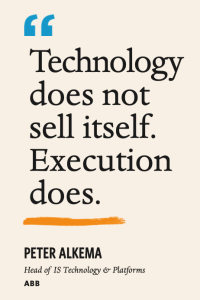
IQ: How do you think about enterprise agility, and when should strategy adapt amid disruption?
Mr. Alkema: You cannot run an entire enterprise purely on agile principles, but you can embed agility into the building blocks of the organization. That matters because when conditions shift, you do not want the business constrained by its own IT function. At the same time, you cannot get too far ahead of the business and build something they do not want or are not ready to sponsor.
What works is creating an environment where IT can act as a catalyst. IT brings ideas, enables the business to test and adapt quickly, and designs processes that support continuous learning. That does not mean everything is endlessly fluid. Major investments still require stability, time, and discipline. You cannot turn an organization on a dime. But within that direction, an agile delivery model lets you keep configuring in ways that stay relevant as the environment changes.
I would always err on the side of being as agile as possible within those constraints. The mistake is either being so rigid that the business cannot adapt, or so disconnected that IT runs off in its own direction.
ABB’s innovation framework speaks to that tension well. There is a disciplined path from ideation to validation to piloting to scalable deployment, with iterative feedback loops and fast validation cycles. That is the balance: enough agility to learn, enough structure to scale.
IQ: Where can AI most improve manufacturing, and what must change to realize its value?

Mr. Alkema: We are going to go through the hype cycle. Every conference has a new buzzword or a new way of dressing up the same conversation. The valuable use cases will emerge once the hype settles. One of the biggest challenges is that advanced AI, especially agentic AI, requires very high-quality, granular context. If you want systems to diagnose and resolve issues with meaningful autonomy, they need a high-fidelity representation of the environment they are operating in. Most companies simply do not have that. Without it, what you are doing is automation rather than true autonomy.
Data is the fundamental issue. The second issue is scaling. Many organizations can demonstrate something interesting once. Far fewer can make it stable, reproducible, integrated, and scalable inside a real industrial setting.
IQ: What is one under-leveraged opportunity in manufacturing today?
Mr. Alkema: There is a significant opportunity in autonomous operations and what some would call the “dark factory.” The direction of travel is clear. We are moving toward environments where systems can see more, interpret more, and increasingly act with less human intervention. But the constraint is not really the technology. It is how it gets implemented. The barriers are often specific to individual factories, regions, leadership teams, and local ways of working. I have seen factories with two different lines running under two different cultures. Very often, the blocker is leadership.
The tools are increasingly available. The determining factor is the priority leaders give them, how close they stay to the operating reality, and whether they create the conditions for those tools to take hold. The best outcomes usually come when you combine local insight with broader organizational capability. That is where you can move productivity materially, improve service, improve quality, and free people up from low-value, repetitive work.
That leadership alignment, for me, is where the under-leveraged opportunity really sits.