

Strategy: Fewer Moves, More Wins
Most of us would agree there’s a meaningful difference between being an art collector versus an art hoarder.
Both have a great many objects. Both have spent years acquiring them. Both can walk you through the provenance of nearly anything in their possession. From the outside, in the right light, you might struggle to tell them apart. The collector chose. That is the difference. Each piece in a real collection earned its place against the alternative of something else, equally desirable, that did not get acquired. The hoarder did not choose. The hoarder said yes, repeatedly, to objects that asked for nothing in return except a bit of room. Over time, the room ran out. Then the hoarder rented more room.
Most enterprise strategies, examined honestly, are hoards. This is not a popular thing to say in a strategy meeting. Strategy meetings are where aspiration is the operative emotion. Every initiative gets framed as a once-in-a-decade opportunity, saying no to anything is treated as a failure of nerve, and the resulting document, weighing in at sixty slides and twelve workstreams, gets called “the strategy” without anyone seeming to notice that a list of everything is not, in any meaningful sense, a strategy at all.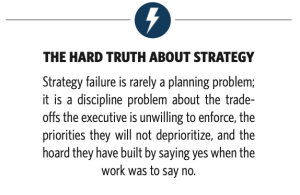
The hard truth is this: if your strategy contains everything you would like to do, you do not have a strategy. You have a hoard. And like every hoard, it will eventually demand more room (more capital, more attention, more capable people) than the enterprise has to give.
Strategy only exists where leaders are willing to say no, and willing to make that no stick. Anything else is curation theater.
What the Data Actually Says
In March 2026, market research firm Hypothesis Group—an Elixirr company—surveyed 100 senior executives at U.S. enterprises with more than $1 billion in annual revenue. The findings on strategy, when read together, describe an executive class that knows it has a problem and has not, by and large, named it correctly.
Of those surveyed, 28% of senior executives identified “too many priorities competed for attention” as a reason their major initiatives failed; 17% identified “trade-offs were avoided rather than confronted” and 23% flagged “ability to translate strategy into actionable plans” as the area where their organizations most overestimated their readiness—the second-largest gap of any factor surveyed.
Read those three numbers together, and a pattern emerges that the respondents themselves seem not to have made. Too many priorities competed for attention. Trade-offs were avoided rather than confronted. We could not translate strategy into action. These are not three separate failures. They are one failure described from three angles. A strategy with too many priorities is a strategy whose trade-offs were avoided. A strategy whose trade-offs were avoided cannot be translated into action, because translating into action requires choosing what to do with finite people and finite capital, which is the very choice that was avoided in the first place.
The senior executives surveyed identified the symptoms. They did not identify the disease, which is that strategy without enforced exclusivity is not strategy. It is a list. And lists do not produce competitive advantage; choices do.

The figure that gets repeated in every consulting deck on the subject, that 67% of well-formulated strategies fail in execution, has been quoted so frequently that it has begun to feel less like a finding and more like an excuse. Strategies do not fail in execution as often as the consulting industry claims. Many of them fail upstream of execution, in the moment when the leadership team had a chance to enforce a trade-off and chose, instead, to keep the menu open.
A Pattern Emerges Across Consumer Goods
The clearest place to watch this happen, in real time, is in consumer packaged goods. Brandon Bichler and Anya Haarhoff, both partners at Elixirr, have spent years observing the pattern across the industry’s largest companies. What they describe is the hoarder problem at the category scale.
“Over time, organizations accumulate large numbers of SKUs and product variations,” says Mr. Bichler. “Each product requires marketing investment, supply chain capacity, and operational attention. In today’s more constrained environment, that complexity can dilute resources and reduce strategic focus.”
The complexity does not arrive all at once, either. It arrives one defensible-at-the-time decision at a time: a brand extension here, a regional variant there, a flanker SKU to compete with a challenger brand, a portfolio acquisition that came with seventeen products no one had quite the conviction to retire. Each decision can be defended on its own merits. The aggregate cannot.
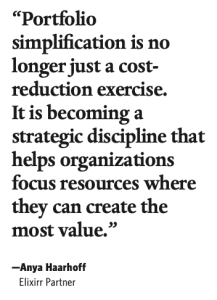
“Portfolio simplification is no longer just a cost-reduction exercise,” echoes Ms. Haarhoff. “It is becoming a strategic discipline that helps organizations focus resources where they can create the most value.”
Portfolio simplification as a strategic discipline is precisely the move most enterprises avoid. They treat simplification as something operations does to clean up after strategy, a tidying exercise, undertaken reluctantly, framed as an admission of past mistakes. It is not. It is the central act of strategy itself. The hoarder does not have a curation problem; the hoarder has a choice problem.
 So too does the enterprise whose portfolio has accumulated past the point where any of it can be defended.
What This Looks Like Inside the C-Suite
Caroline Tillett, PhD, is Chief Scientific Officer at Kenvue, where she leads a global R&D organization spanning skin health and self-care. She has lived inside the strategy-as-hoard problem at multiple Fortune-class consumer health companies and has thought about it more clearly than most people who hold her title.
Asked where strategy typically breaks down between leadership and execution, Dr. Tillett did not name capability gaps or organizational dysfunction. She named a discipline failure, and she named it precisely.
“Strategy requires saying, and sustaining, a clear set of commitments, while also having the courage to adapt when learning reveals something material that was not visible at the onset,” Dr. Tillett says. “In my experience, it most often breaks down in discipline. At the leadership level, the real work lies in ensuring that what we said we would do continues to receive focus, resources, and accountability. At the same time, leaders must make deliberate choices about what they will and will not do outside of the original plan. Execution begins to falter when strategy becomes additive instead of selective, when emerging insights are simply layered on rather than integrated through conscious trade-offs.”
To Dr. Tillett’s point, execution begins to falter when strategy becomes additive instead of selective.
Most leaders, asked to name the moment a strategy started failing, will point to a quarter when results slipped or a project that ran over budget. Dr. Tillett is pointing to a much earlier moment: the moment when an emerging opportunity was added to the strategy rather than integrated into it through a deliberate choice about what would now have to give. That moment, repeated across a year, is how a real strategy becomes a hoard. Not through any single bad decision. Through a hundred small refusals to choose.

Dr. Tillett is sharper still on what makes the choice hard.
“Leaders tend to struggle most at the point where optionality feels safer than focus,” she says. “It can be tempting to add brands, SKUs, or innovation bets under the belief that breadth creates resilience. In reality, however, unchecked expansion dilutes both impact and differentiation.”
This is the heart of it. Optionality feels safer. The leader who refuses to kill an initiative, refuses to deprioritize a product line, refuses to say no to a customer segment: that leader feels prudent. They are protecting against the scenario in which the killed initiative would have been the winner. They are managing risk. They are being responsible.
They are also, in aggregate, building a hoard. And the hoard is not safer than the collection. The hoard simply pushes the cost of indecision into the future, where it shows up as diluted resources, confused teams, and a market position that is harder to articulate every quarter.
“When everything is treated as a priority, nothing truly stands out to the consumer or influences their decision to choose a product or brand,” says Dr. Tillett. “Strategy demands the discipline to ask: what will this brand be known for? And just as importantly, what will it deliberately not pursue?” This is what distinguishes a strategy from a list. Yet, many enterprise strategies cannot see the forest for the trees.
The Methodology That Begins by Forcing the Choice
There is a way of building a strategy that begins by forcing the choice rather than postponing it. It is called the “strategic frame,” and it is a five-part construction: purpose and ambition, stakeholder commitments, guiding beliefs, competitive weapons, and strategic outcomes. None of those words is unfamiliar to a senior executive. What makes the methodology distinct is not the vocabulary. It is what the framework refuses to do.
A strategic frame does not produce a plan. It produces a decision-making lens. The point is not to settle, in advance, every choice the enterprise will face; that is impossible in a market where disruption arrives from any direction at any time, and where the strategic plan written in January is often obsolete by July. The point is to give the executive a frame from which they can keep making defensible choices as the future emerges. The frame is the apparatus that turns a hoard into a collection.
Purpose and ambition do the foundational work; they name what the enterprise is for and what victory looks like. Stakeholder commitments name the unbreakable obligations that constrain every subsequent choice. Guiding beliefs are the bets the enterprise is making about how the future will unfold; they are the assumptions on which strategy stands or falls.
Competitive weapons are the assets (patents, customer relationships, channel access, cultural distinctiveness, financial capacity) the enterprise will use to win. Strategic outcomes are the specific, measurable results the frame is intended to produce.
What the frame forces, and what most strategic plans avoid, is the moment of integration. Once the components are filled in, the enterprise is supposed to be able to look at any new opportunity and ask: Does this fit our purpose? Does it threaten our stakeholder commitments? Does it depend on a guiding belief we have not yet validated? Does it build our competitive weapons or dilute them? Does it advance a strategic outcome, or merely add a new one we have not chosen to pursue? An opportunity that survives those five questions belongs in the strategy. An opportunity that fails any of them does not.
The work of the strategic frame, in other words, is not the document. It is the discipline of choosing again, every time something new appears.
What Enforced Exclusivity Looks Like in Practice
Consider a global health care conglomerate that held the leading market share in a particular surgical technology for 50 years.
The technology was sound, the customers were loyal, and the margins were good. Then the trend lines started to flatten. Medical advancement was making the technology look, to anyone willing to read the curves honestly, a generation away from obsolescence. A team of about 20 senior managers was given a target: find $150 million in new revenue within three years. The team made no progress for six months.
What surfaced was not a market problem. The team had been operating under two unwritten assumptions. The first was that management already knew the answer; the senior managers’ job was to figure out what the executives wanted and sell it back. The second was that the business was defined by the existing technology; any new product had to be a variant of what the company already made.
Neither assumption was true. The executives were genuinely asking the team to invent one. And the business was not the existing technology. The business was serving surgeons and their patients, a definition that opened a field of new product opportunities the existing technology had artificially closed.
Once the team named both assumptions and broke from them, it redefined the business at the level of what it was for. From that redefinition, a portfolio of new products became visible that had been invisible the day before. The team designed a strategy projected to deliver more than $500 million in growth—over 3X the original target.
This is what enforced exclusivity looks like. The choice was not “which products to build” but “what is the business actually for?”, and the answer was selective enough to make every subsequent decision either yes or no.
Strategy is what the organization deliberately chooses to do at the cost of what it deliberately chooses not to do. The companies that hold those choices build collections. The rest accumulate hoards.
The Discipline Question
Here is what the AI moment is going to make worse. Every CXO in every industry is currently sitting in front of a meeting where someone is proposing to “do something with AI.” Most of those proposals are going to be approved. Most of those approvals will be rationalized as protecting against the scenario in which AI turns out to matter, and the enterprise was caught flat-footed. Most of them will turn into pilots that multiply, line items that grow, and a portfolio of AI activity that adds up, in aggregate, to no coherent thesis about what the enterprise is using AI to do. This is not an AI problem. It is the strategy problem that has always existed, now operating at the velocity AI permits. The pressure to add an AI initiative is exactly the pressure Dr. Tillett described; optionality feels safer than focus, playing out at machine speed. Most enterprises chasing AI parity are doing so at the expense of the discipline that would have asked, before the first pilot was approved, what our use of AI will be known for, and what we will deliberately not pursue? Many enterprises cannot answer that question. The ones that can are the ones that already have a working frame. The rest are about to add AI to the hoard.
Creating the Future
If your strategy contains more than three to five things your enterprise is committing to, you do not have a strategy. You have a list. The first work is not to refine the list. The first work is to identify which two or three commitments would, if pursued with real exclusivity, distinguish the enterprise, and to be willing to say, in front of the people who own the rest, that the rest is not strategic. It may be operational. It may be profitable. But if it does not distinguish, it does not belong in the strategy.
This is harder than it sounds because the items being demoted have champions, and those champions have been promised, by previous strategies, that their work was central. Removing items from the strategy is an act of leadership that requires explaining to capable people why the work they care about is no longer the work the enterprise is choosing to be defined by. There is no painless version of that conversation. There is only the version where the leader has it, and the version where the strategy continues to grow until the enterprise can no longer hold its shape.
CXOs willing to enforce that discipline, to choose what the enterprise is for, and to walk away from the optionality that feels safer than focus, are the ones whose strategies will outperform the market and overcome the hard truths. Their enterprises, over time, are the ones whose names mean something specific in their categories. Their competitors will be acquiring, expanding, and explaining to investors why this quarter’s results do not yet reflect the long-term thesis.
Collectors and hoarders both have a great many objects. Only one of them has built a collection.
Executive Perspective
Dr. Caroline Tillett is the Chief Scientific Officer for Kenvue. In this role, Dr. Tillett oversees a multi-faceted Research & Development organization, including New Product & Packaging Development, Sustainability, Medical Safety, and Regulatory Affairs. A consumer health leader with more than 20 years of experience, she has advanced science-based innovations from development through commercialization, with a focus on growth, sustainability, inclusive innovation, and improving personal health and wellness globally.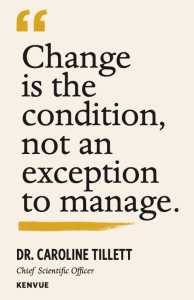
IQ: How should leaders think about strategic adaptation without losing strategic discipline?
Dr. Tillett: The leaders I admire most have a firm grip on the intent and a flexible grip on the path. The plan will evolve. The intent should not. When teams understand why a commitment exists, not just what was committed to, they can make sound decisions when reality changes without abandoning the strategy or expanding it past coherence. That kind of clarity is what allows an organization to adapt confidently rather than reactively. Most strategic failures I have seen come from the opposite condition: a rigid plan and a foggy intent.
IQ: What does it take to translate strategy into something a workforce can actually execute against?
Dr. Tillett: Strategy lives or dies in translation. A clearly articulated strategy at the top of the house is necessary but not sufficient. The leadership work is in making sure each function and each team can answer, in their own words, how their daily decisions advance or distract from the strategic commitments. When that line of sight breaks, the strategy becomes a slide deck rather than an operating principle. The teams that execute well are the ones whose people can name the trade-offs the strategy is making, not just the ambitions it is pursuing.
IQ: How do you think about AI and emerging technology in the context of strategic focus?
Dr. Tillett: AI is going to test strategic discipline more than any other force I have seen in my career. The pressure to do something with it will be enormous. The temptation will be to add AI initiatives across every part of the business as a defensive move. But strategy demands that we ask the same question of AI we should ask of any new commitment: does this advance what we are trying to be known for, or does it dilute it? The leaders who hold that line will get more value from AI than the ones who scatter pilots across the enterprise.
IQ: How should leaders decide when a change in consumer behavior requires a strategic pivot, versus disciplined consistency?
Dr. Tillett: Consumer behavior is the ultimate arbiter of success in CPG, and at the heart of everything we do. If innovation does not align with consumer needs, behaviors, and preferences, it will not drive growth. The distinction between pivoting and staying the course comes down to insights versus noise. Leaders must continuously monitor consumer perceptions and be prepared to evolve with them, while avoiding reactive shifts that undermine long-term investment in innovation. No amount of downstream investment — from marketing to distribution — can compensate for a product that misses the consumer’s sweet spot. Strategic consistency matters, but it must always be in service of a consumer reality that is actively understood and revisited.
IQ: Where are you seeing AI genuinely improve decision-making—and where does the value remain unclear?
Dr. Tillett: In areas like consumer insights, forecasting, and research efficiency, it has dramatically increased decision velocity. But what remains unclear—and irreplaceable—is judgment. AI can surface correlations and predict behaviors at scale, but it does not understand context, emotion, or consequence. The real value of AI emerges when it augments human critical thinking rather than attempts to replace it. Strategy, prioritization, and ethical decision-making remain firmly human responsibilities—and perhaps that is exactly as it should be.