
Mastering The M&A Pressure Test
For leadership teams facing structural uncertainty, the real differentiator is no longer strategy—it is execution. Most companies know where they want to go, but far fewer can mobilize their organizations with the speed, discipline, and precision required to get there. In volatile markets, hesitation masquerading as caution slows momentum, erodes competitive position, and limits optionality. What separates the leaders from the laggards is their ability to translate intent into action—and to do so consistently, even when visibility is low.
Increasingly, executives are turning to mergers and acquisitions not as episodic transactions, but as a core execution engine. When treated as a disciplined operating system rather than a reactive lever, M&A becomes a powerful mechanism for building capabilities, reshaping portfolios, and accelerating strategic priorities. In this environment, the winners are not simply the most aggressive acquirers—they are the ones who execute with clarity, conviction, and repeatable rigor. M&A, at its best, becomes a test of execution excellence: the capacity to move faster than uncertainty, integrate with purpose, and convert strategic ambition into measurable value.
A proprietary analysis of 150 fast-growing mid-market firms in professional services across the U.S., U.K., and Europe reveals a distinct pattern: the winners are not the biggest or fastest. They are the most intentional. In their hands, M&A becomes a discipline, not a gamble; a catalyst for resilience, not just scale.

Volatility Rewards Clarity, Not Hesitation
Global M&A activity has slowed to its lowest level in over a decade. Rising interest rates, geopolitical instability, and jittery markets have prompted many companies to delay or abandon transactions altogether. In early 2025, U.S. deal volume fell 34 percent year-over-year, reaching its lowest quarterly level since 2005. Yet history is clear: volatility rewards boldness when it is methodical. During past downturns, companies that pursued acquisitions with strategic clarity and execution rigor frequently outperformed peers in the recovery.
The M&A playbook itself is also evolving. Traditional models—long cycles, slow diligence, and broad synergy bets—are giving way to faster timelines, AI-augmented diligence, real-time integration tracking, and more founder-aligned deal structures. Recent surveys show that 77% of M&A practitioners now use AI in their deal process, and 71% apply it to value-creation modeling. In this environment, M&A is no longer just a capital-allocation lever. It is a dynamic leadership capability—one that must adapt, orchestrate, and respond in real time.
Why the Best M&A Is Born in Downturns
Traditional levers like organic expansion, new hiring, and product roll-outs are faltering under macroeconomic pressure. As cyclical playbooks break down, the companies that thrive are those that architect growth, rather than wait for it.
High-judgment M&A becomes the proving ground for executive teams. When executed with discipline, acquisitions can generate significant competitive advantage. Yet, when misaligned, they can amplify strategic risk.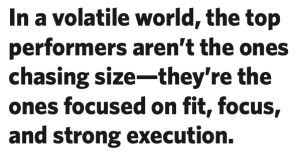
During the 2009 financial crisis, average U.S. deal multiples fell to 6.5x EV/EBITDA, down from 10.8x in 2005. By 2019, valuations rebounded to 11.6x. One Harvard study found that acquirers who acted during the 2008–2010 downturn achieved 6.4% shareholder returns, compared to –3.4% for those who abstained.
Today, that dynamic is playing out again. Global deal value in the first half of 2025 rose approximately 22% to $2 trillion, marking a meaningful rebound even as deal volume remained flat. Private-equity-led transactions surged to ~$471 billion globally in the same period, up more than 30% year-over-year.
Making M&A a Strategic Operating System
In an environment where disruption is constant and planning cycles can’t keep pace, M&A must function as a system—repeatable, disciplined, and execution-driven.
The most successful acquirers treat M&A much like value investors treat markets: with long-term conviction, a clear thesis, and a focus on fundamentals. They know exactly what they are looking for and why.
Elixirr’s proprietary data shows that the most attractive acquisition targets tend to be small—often fewer than 150 employees—with two to four tightly interlocking capabilities. These firms exhibit high efficiency, with revenue per head (RPH) above £250,000 and, in top cases, exceeding £350,000.
This isn’t just financial efficiency. It is a marker of structural clarity, cultural cohesion, and pricing power. Small, sharp, and efficient firms are easier to integrate, offer clearer synergy pathways, and often create more defensible value. Unsurprisingly, 38% of corporates now cite “growth of the core business” as their primary M&A objective.

Inside the Winners’ Circle: The Rise of Hidden Champions
Elixirr’s analysis reveals a counterintuitive truth: the most efficient companies aren’t the biggest—just the clearest. Among them emerges a category of “hidden champions”: compact firms with multiple capabilities and exceptional productivity.
These companies outperform both highly specialized and heavily diversified peers. They prove that market-leading value can be delivered at modest scale—when structure, strategy, and execution align.
Their advantage is structural. Lean models reduce delivery drag; strategic precision creates pricing power; and tight customer integration boosts retention and renewals. For acquirers, these firms represent value disproportionate to their size—often justifying premium multiples due to cleaner integrations and higher post-merger leverage.
Mid-market sentiment reflects the same trend: more than half of midsize-business decision-makers expect the M&A market to be strong in 2026.
Where Most Don’t Look: Geography as a Signal, Not a Constraint
While deal-making has historically concentrated in London, New York, and San Francisco, some of the highest-performing targets now emerge from less traditional markets: Copenhagen, Edinburgh, Zurich, and Los Angeles. These locations consistently deliver superior revenue-per-head metrics.
Denmark and Switzerland stand out with strong EBITDA margins and exceptionally lean team structures. These markets benefit from dense talent pools, strong education systems, and lower operational friction.
Moreover, deal-flow is shifting globally. Asia-Pacific and secondary European cities are now contributing meaningful volumes of high-value deals, driven by regulatory modernization and corporate globalization. For acquirers, this widens the aperture.
The assumption that value lives only in marquee cities is increasingly outdated. Secondary markets often offer better fundamentals, lower saturation, and structurally resilient business models.
What Top Firms Reveal About Scale, Talent, and Limits
Elixirr’s data also highlights a structural truth: in human-capital-based businesses, there is a ceiling to productivity. While high RPH is a hallmark of efficient firms, only four companies in the dataset exceed £350,000 per employee—and none surpass £500,000.
This indicates that beyond a certain point, further productivity requires structural innovation, not just talent. Firms approaching the upper bound of RPH often rely on proprietary IP, technology-enabled delivery, or nonlinear economics—signals that they may not be traditional services firms at all.
Given current trends, acquirers increasingly screen for these scalable, nonlinear models—especially those leveraging AI, software-enabled services, and high-margin intellectual property.
Execution Is the Differentiator
It’s widely cited that roughly 70–75% of acquisitions fail to meet expectations. The drivers are familiar: weak strategic alignment, faulty valuation assumptions, and poor integration execution. In today’s volatile environment, the cost of failure is even higher. The differentiator is execution. This is why successful acquirers anchor every deal in long-term strategic fit, maintain valuation discipline, and apply equal rigor to financial, operational, and cultural diligence. Integration planning starts before signing, not after closing.
Recent research underscores the stakes: announced cost synergies in early 2025 were nearly double those in 2015, and revenue synergies grew eightfold. Rapid value capture is no longer optional—it is expected. And cybersecurity has also become a critical diligence risk; weak cyber posture can now derail deals before closing, making technology and security diligence as central as financial review.

Final Word: M&A for a New Day
In a world of persistent volatility, the best-performing firms are not those chasing scale but those optimizing for fit, focus, and execution. Their edge comes from clarity of value and the agility to pursue it.
While overall deal volume remains subdued, strategic acquirers are already moving—using disciplined M&A to reshape capabilities, redeploy capital, and outpace cautious competitors.
M&A has become more than a growth lever. It is a test of enterprise agility and leadership acuity: How quickly can your organization evaluate opportunity? How precisely can it structure and integrate? How confidently can it act when visibility is limited?
When companies follow this kind of disciplined, strategy-led M&A approach—starting with a clear investment thesis, screening for structurally efficient targets, diligencing leadership, culture, and operating model, and planning integration from day one—M&A becomes a force multiplier for corporate execution. Instead of sitting alongside the strategy, each deal extends and operationalizes it: filling capability gaps, redeploying capital into the most attractive segments, and accelerating access to technology, talent, and markets that would take years to build organically.
Research on successful acquirers shows that when transactions are tightly linked to enterprise goals and underpinned by robust integration plans, they are far more likely to realize the cost and growth synergies that flow through to earnings, cash generation, and, ultimately, durable gains in shareholder value.